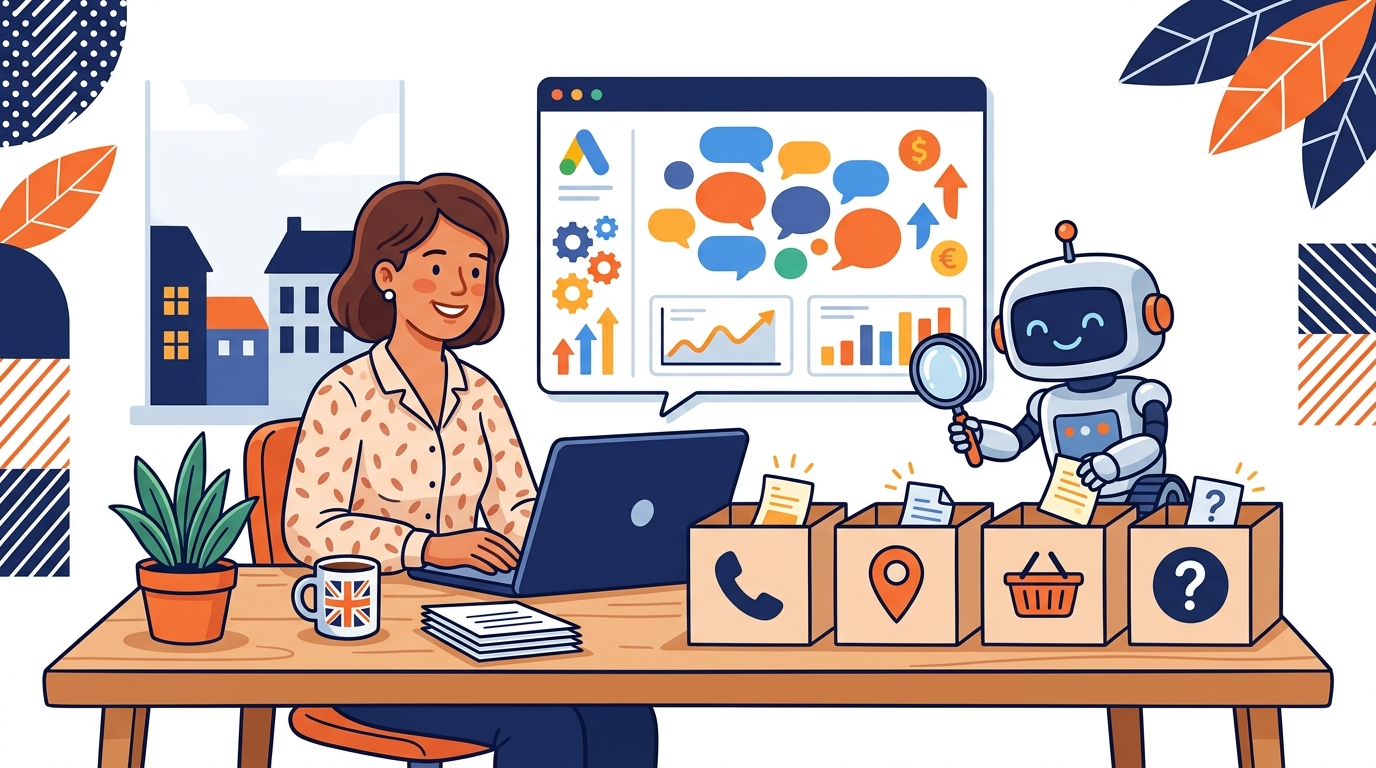
Google Ads AI search terms are getting weirder. Not useless. Not magic. Just weirder. As Google pushes more AI into Search, AI Overviews, Lens, autocomplete, AI Mode and campaign reporting, advertisers need to stop treating search terms like a neat little transcript of what someone typed at 11:42pm while panic-buying a plumber.
That old habit is cosy, but it is becoming less reliable. Google has been moving towards intent-led matching for years. Now the pace is picking up, with Gemini-powered reporting, AI Mode ads and more automated campaign decisions getting louder ahead of Google Marketing Live 2026. For small businesses, the message is simple: your ad account needs better inputs, better judgement and far less blind trust in the machine.
Google Ads AI search terms are intent clues, not courtroom evidence
The search terms report used to feel satisfyingly literal. Someone searched for a thing, your ad showed, and you could decide whether that thing deserved more budget or a big fat negative keyword.
Now, Google is dealing with a much messier search journey. People use voice search, images, autocomplete suggestions, AI summaries and conversational queries. Google then interprets what it thinks the person meant. Your report may show a best approximation of intent rather than the exact words that started the journey.
That matters because intent is useful, but it is not the same as detail. If you sell emergency boiler repairs in Leeds, you care deeply about the difference between someone researching boiler grants, comparing boiler brands and desperately needing help before the house turns into an ice cube.
AI can group those signals. It can also blur them. Helpful little gremlin, slightly chaotic paperwork.
AI Mode ads mean your landing page has to do more heavy lifting
Ads appearing inside AI-led search experiences are not just another placement to tick in a settings menu and then forget about. They change the context. A person may already have read an AI-generated answer before they see your advert. They may be comparing options faster. They may arrive on your site with a more specific problem and a shorter attention span.
So yes, your landing page matters. A lot.
If your page opens with fluffy nonsense about being passionate, customer-focused and committed to excellence, please know that the internet has heard enough. Tell people what you do, who it is for, where you do it, what happens next and why they should trust you. Make the call button obvious. Put proof near the offer. Answer the awkward questions before your competitor does.
AI-driven ads can get someone to the door. Your landing page still has to open it without making them solve a puzzle.
Your conversion tracking cannot be held together with vibes
The more automated Google Ads becomes, the more important your conversion data becomes. That sounds obvious, yet plenty of small business accounts still track one weak conversion and then wonder why the algorithm keeps chasing rubbish leads like a Labrador with a crisp packet.
If Google is using AI to make more decisions, it needs clean signals. That means tracking the actions that actually matter. Calls from qualified prospects. Form fills that include enough detail to judge quality. Booked appointments. Purchases. CRM stages. Repeat customers. Revenue where possible.
Do not train the system to celebrate every button click as if it just won a BAFTA. A newsletter signup is not the same as a booked consultation. A two-second visit to your contact page is not the same as a serious enquiry. Feed Google nonsense and it will optimise for nonsense with terrifying confidence.
Negative keywords are still not dead, despite what the robots imply
Every few months, someone declares that keyword control is finished. Lovely dramatic energy. Still wrong.
Negative keywords are not glamorous, but they are still one of the simplest ways to stop obvious budget leaks. If your search terms show intent drifting towards jobs, free templates, DIY fixes, competitor research or services you do not offer, clean it up.
The trick is not to panic and block everything that looks a bit odd. With AI-led matching, some reports will look less literal. Look for patterns. Are poor quality leads coming from a certain theme? Are people asking for a service you never provide? Are clicks coming from bargain hunters when you sell premium work? That is where negative keyword hygiene earns its keep.
Small, regular clean-ups beat one dramatic account purge after three months of budget pain. Marketing, annoyingly, rewards consistency. Very rude of it.
First-party data is your unfair advantage
If platforms are getting more automated and reporting is getting more interpreted, your own data becomes more valuable. Not in a creepy way. In a useful, grown-up, stop-guessing way.
Your CRM should show which leads became customers, which services made profit, which campaigns brought repeat work and which enquiries wasted everyone’s time. That information should shape your ads, offers and follow-up. Otherwise, you are letting Google optimise from half the story while the useful half sits in a spreadsheet called Final Leads Really Final 4.
This is where a proper marketing and CRM setup pays for itself. Automagical, for example, can help small businesses connect enquiries, follow-up, pipeline stages and customer journeys in one place. That gives your marketing decisions actual evidence instead of vibes in a blazer.
What small businesses should do now
You do not need to panic about Google Ads AI search terms. You do need to stop running campaigns like it is 2019 with a fresh coat of AI glitter.
- Check your conversion tracking and remove weak signals from your main optimisation goals.
- Review search terms for intent patterns, not just exact wording.
- Keep a sensible negative keyword list and update it regularly.
- Improve landing pages so they match real customer problems, not internal jargon.
- Connect your CRM data so you know which leads became valuable customers.
- Let automation help, but keep a human in charge of the strategy.
AI is not replacing marketing judgement. It is punishing lazy setup. Bit harsh, but fair.
The bottom line
Google is clearly moving towards more AI-led advertising. Search terms are becoming more about interpreted intent. Ads are creeping into more AI-powered experiences. Dashboards are getting smarter. Campaigns are getting more automated.
That does not mean small businesses should hand over the keys and hope the robot has a nice personality. It means your setup matters more. Your data matters more. Your landing pages, follow-up and customer journey matter more.
If you want help making your marketing less messy and your follow-up less manual, talk to Precise Impact. We help small businesses build smarter systems, better campaigns and far fewer spreadsheets with suspicious names.