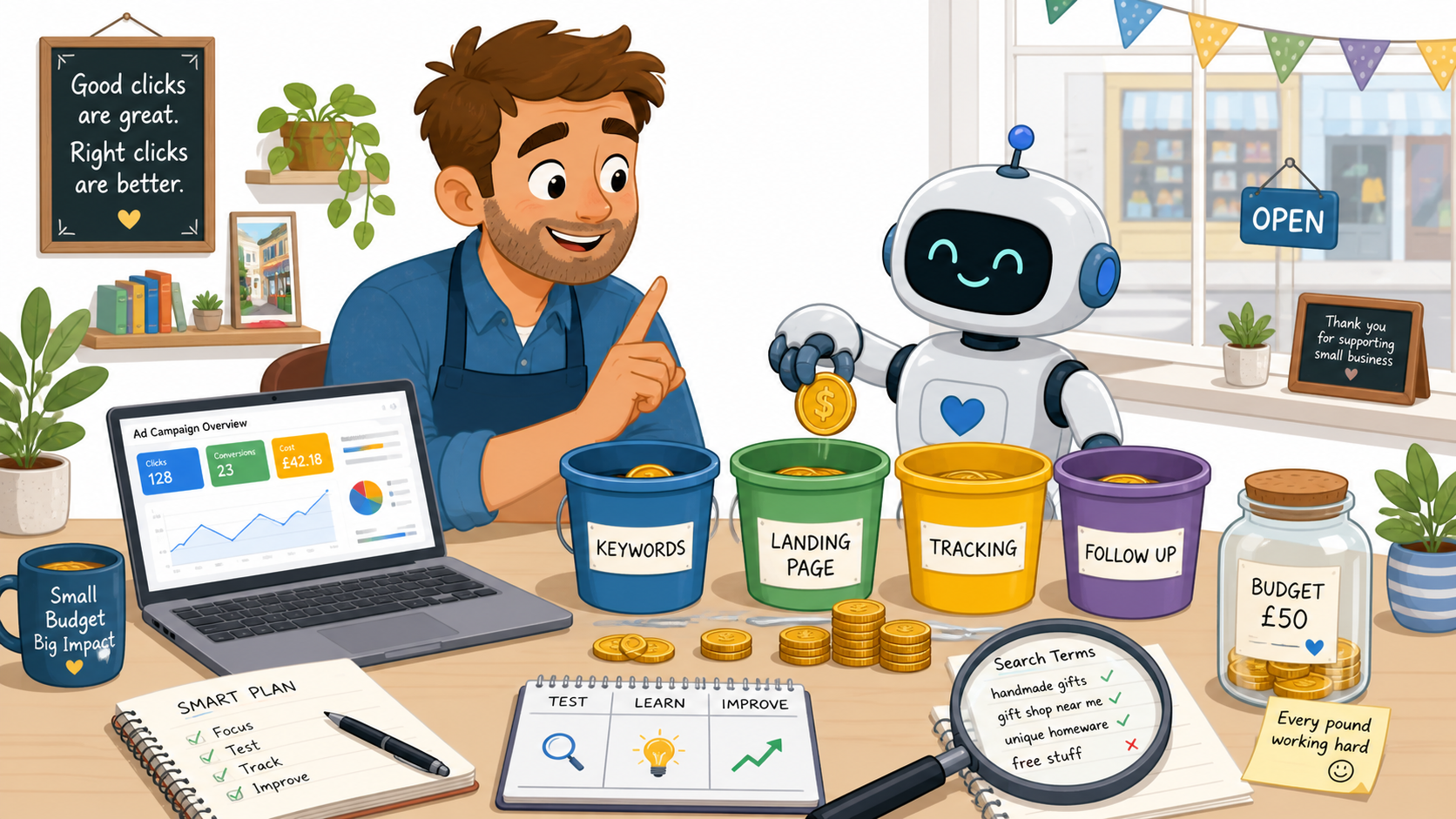
Meta Advantage+ creative is getting a lot of attention, and fair enough. The ad machines are getting smarter. They can test faster, mix assets, find pockets of audience behaviour and make small budget decisions while you are busy doing actual business owner things, like chasing invoices and wondering why the printer has chosen violence.
Lovely. Helpful. Potentially powerful.
But here is the bit small businesses cannot afford to miss. Automation does not magically turn weak creative into profitable advertising. It just spreads the weakness around with more confidence.
If your Meta ads are running on blurry product photos, vague headlines, tired captions and a landing page that looks like it last had a decent conversation in 2018, Advantage+ is not the villain. Your inputs are.
Meta Advantage+ creative is a tool, not a miracle worker
Meta has been pushing more AI-led ad features because advertisers want better performance with less fiddling. That makes sense. Most small business owners do not want to spend their evenings manually adjusting placements, audiences and bid settings. They want leads, sales and a marketing system that does not require a second personality.
Advantage+ can help by using Meta’s data to decide who sees which version of your ad. It can test combinations of creative, copy and placements more quickly than a human would. It can spot signals you would probably miss.
What it cannot do is invent a compelling reason for someone to care about your business.
That bit is still on you. Or your marketing team. Or, if we are being useful rather than dramatic, your strategy.
Bad creative gives the algorithm bad choices
Think of Meta Advantage+ like a very fast assistant. If you give it ten strong assets, it can test them, learn from them and put more budget behind the winners. If you give it ten nearly identical graphics with tiny text, muddy colours and a headline that says something thrilling like “Quality service you can trust”, it has very little to work with.
The algorithm needs contrast. It needs different hooks, different angles and different formats. It needs proof. It needs images that make sense in half a second because people are scrolling, not settling in with a cup of tea and a magnifying glass.
Small businesses often underfeed the creative side because it feels fluffy compared with targeting and budget. That is backwards. Creative is often the thing people actually notice. Targeting gets you into the room. Creative decides whether anyone looks up.
What good Meta Advantage+ creative looks like
You do not need a film crew, a giant brand department or a designer who uses the word “conceptual” too often. You do need variety and clarity.
- Show the product, service or outcome clearly.
- Use real customer language, not polished brochure fog.
- Create separate assets for different pain points.
- Test short videos, simple graphics, founder-led clips and customer proof.
- Make the first line of copy do some actual work.
- Keep mobile viewing in mind because that is where most people will see it.
If you are a local service business, test one ad about speed, one about trust, one about price clarity and one about the annoying problem your customer wants gone by Friday. If you sell products, test lifestyle shots, close-ups, reviews, bundles and simple demonstrations.
Do not make five tiny variations of the same beige square and call it testing. That is not a creative strategy. That is a cry for help in brand colours.
Your offer still has to be worth clicking
Even brilliant creative cannot fully rescue a weak offer. If your ad sends people to “contact us” with no context, no urgency and no clear next step, you are asking cold traffic to do emotional admin. Most will not.
A stronger offer gives the algorithm something useful to optimise around. That could be a free consultation, a limited seasonal package, a useful download, a quote request, a trial, a booking page or a specific product bundle. The key is that the next step feels obvious and worthwhile.
Small business ads work best when the promise is simple. Not smaller, necessarily. Just clearer.
The landing page cannot be an afterthought
Meta can send you clicks. It cannot make your landing page behave.
If people click through and find a slow website, confusing page, missing prices, weak proof or a form with more fields than a mortgage application, performance will suffer. Then everyone blames the ads, because apparently the ads are easier to shout at.
Your landing page should match the ad promise. Same offer, same language, same audience, same next step. Add customer reviews, answer the obvious objections and make it stupidly easy to enquire, book or buy.
Good ad automation plus a poor landing page is like hiring a brilliant waiter and sending them into a restaurant with no kitchen.
Follow-up is where money quietly leaks out
Here is the part many businesses still ignore. Someone clicks, fills in a form, sends a message or downloads a guide. Then what?
If the answer is “we try to remember to reply later”, your Meta ads are funding a very expensive memory test.
Fast follow-up matters. So does proper tracking. Leads should land in a CRM, receive a relevant response, get tagged correctly and move through a pipeline that someone can actually manage. If they do not buy straight away, they should still hear from you again in a useful, non-annoying way.
This is where an all-in-one marketing and CRM platform like Automagical earns its keep. Your ads, forms, contacts, follow-ups, emails, automations and pipeline can work together instead of sitting in separate apps pretending they have never met.
What to do before giving Meta more budget
Before you increase spend, fix the basics. Boring, yes. Profitable, also yes.
- Build a bank of genuinely different creative assets.
- Write hooks for real customer problems, not vague benefits.
- Check that every ad leads to a matching page or form.
- Set up CRM tracking so every enquiry has a clear next step.
- Create automatic follow-up for leads that do not convert immediately.
- Review results by creative angle, not just campaign name.
Meta Advantage+ creative can absolutely help small businesses advertise more efficiently. But it works best when it is fed with strong ideas, clear offers and a follow-up system that does not fall over the second someone shows interest.
The future of paid social is not “let the robots handle everything”. It is smarter automation paired with sharper marketing judgement. Less button mashing. More grown-up strategy.
If your Meta ads are getting clicks but not enough customers, Precise Impact can help you sort the creative, the follow-up and the system behind it. Automagical might be exactly what you need if you are tired of leads disappearing into the void.